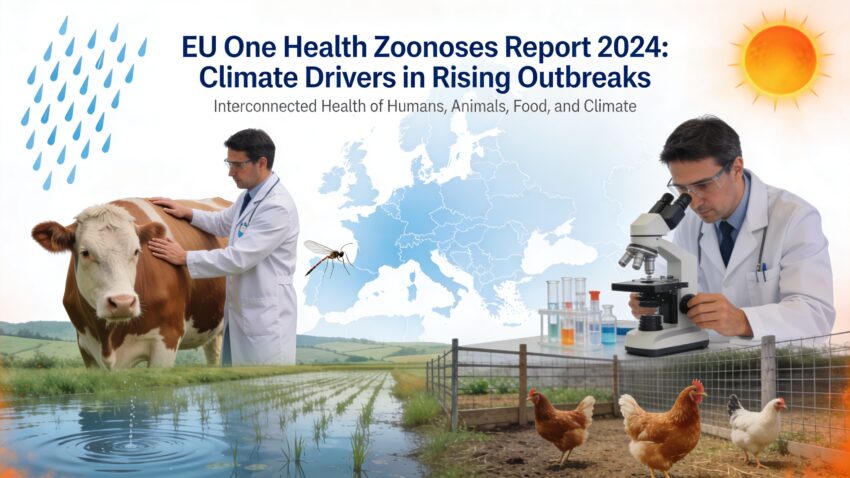
The European Union One Health Zoonoses Report 2024 is the most recent full annual summary of zoonotic disease trends in the EU. It brings together data on infections that pass between animals and humans, findings from food-borne outbreak investigations, and surveillance results from public health, veterinary, and food safety systems. For anyone trying to understand zoonotic risk in Europe in 2026, it is the clearest official reference point currently available.
The report matters because it shows where the main burden still lies. It is easy to focus on rare or dramatic threats, but the largest share of zoonotic illness in Europe still comes from well-known pathogens that continue to circulate through food systems, livestock, wildlife, and the wider environment. It also shows why One Health remains useful as a working framework rather than a policy slogan. Human health, animal health, food production, and environmental conditions are closely linked, and disease trends make less sense when these areas are treated separately.
What does the report cover?
The report is a joint overview of zoonotic infections, food-borne outbreaks, and related monitoring across EU member states. It looks at human cases, animal reservoirs, food contamination, and outbreak patterns. In practical terms, it is an annual attempt to describe how zoonotic disease moves through the European system and where the main public health pressures remain.
It covers pathogens that appear regularly in European surveillance, including Campylobacter, Salmonella, Listeria monocytogenes, Shiga toxin-producing E. coli, Yersinia, Brucella, Trichinella, and other zoonotic agents monitored through food, animals, and public health reporting. Some of these pathogens cause large numbers of infections each year. Others are less common but more severe. That distinction matters, because burden is not only about how often an infection occurs, but also about how serious the outcome can be.
What are the main findings?
The clearest finding is that zoonotic disease remains a steady public health issue across Europe. The report shows continued high levels of illness from the pathogens that have dominated EU surveillance for years, especially Campylobacter and Salmonella. It also notes an increase in reported food-borne outbreaks compared with the previous year.
That pattern matters because it shows that the main challenge is not limited to unusual spillover events. Much of the burden comes from familiar organisms moving through established routes such as food production, animal reservoirs, processing failures, contamination, and household handling. This is less dramatic than an emerging epidemic, but it is more relevant to daily public health and food safety practice.
Listeriosis also deserves attention. It usually causes fewer cases than Campylobacter or Salmonella, but it is often more severe, especially for older adults, pregnant women, newborns, and people with weakened immune systems. A useful reading of the report therefore requires more than looking at the largest numbers. It also requires looking at severity, vulnerability, and the settings in which infections occur.
Why is Campylobacter still so important?
Campylobacter remains the most frequently reported zoonosis in humans in the EU. This is important because it shows that routine zoonotic risk is still shaped by common pathogens rather than only by rare emerging threats. Campylobacter is strongly associated with poultry, food preparation, and contamination pathways that are difficult to remove completely even in highly regulated food systems.
Its persistence shows how zoonotic disease often works in practice. A pathogen does not need to be new to remain a serious public health problem. It only needs to keep finding reliable routes through farming, slaughter, processing, retail, kitchens, and water systems. That is why steady surveillance matters. The same route that looks routine can still produce a large burden when small failures happen repeatedly across a large system.
Campylobacter is also relevant because it sits at the intersection of food safety and environmental pressure. Heat, rainfall, water quality, seasonal variation, and farming conditions can all influence the wider setting in which infections occur. These factors do not replace more familiar causes such as hygiene failures or undercooked poultry, but they can change the conditions around risk.
How does climate change fit into the picture?
Climate change does not act as a single explanation for zoonotic disease trends. It changes the conditions in which pathogens, vectors, hosts, food systems, and human behaviour interact. That makes it an important pressure rather than a simple cause. A rise in cases cannot automatically be blamed on climate. At the same time, climate should not be treated as irrelevant just because it works through indirect pathways.
In Europe, climate-related effects can include warmer temperatures, milder winters, heatwaves, heavy rainfall, flooding, drought, and changes in seasonal patterns. These shifts may affect water quality, livestock stress, wildlife movement, vector survival, pathogen persistence, and food storage conditions. The effect is often cumulative. Climate pressure adds instability to systems that already contain biological and logistical weak points.
This is why the climate discussion needs care. Overstatement is not useful. Not every rise in infection reflects a climate signal, and not every climate-related hazard produces measurable disease change. The practical point is narrower and more defensible: environmental shifts can alter the conditions under which zoonotic risks emerge, spread, or become harder to control.
Which climate-linked pressures matter most in Europe?
Several pressures stand out in the European context. Temperature changes can lengthen the active season for some vectors and support the spread of others into areas where risk was previously lower. Heavy rainfall can increase runoff and contamination in water systems. Flooding can disturb sanitation, farming infrastructure, and local exposure patterns. Drought can reshape how livestock are managed and how wildlife and farm animals interact around limited water sources.
Land use also matters. Disease risk is affected not only by temperature but by how landscapes are used. Urban expansion, agricultural intensification, habitat fragmentation, and changes in wildlife movement all reshape contact between species. When people discuss zoonotic disease only in medical terms, they miss the fact that many risks are produced at the edge of ecology, agriculture, infrastructure, and public health.
These are not always rapid changes. Some build slowly over years. That is one reason annual reports matter. They help show whether patterns that once looked local or temporary are becoming more consistent over time.
Why does One Health matter here?
One Health matters because zoonotic disease does not stay within one sector. A rise in human cases may start with animal infection, contamination in food, a change in vector activity, or an environmental exposure pattern. If public health, veterinary, and food safety systems work in isolation, early signals are easier to miss.
In practical terms, One Health means different systems contribute to the same picture. Doctors and laboratories identify human illness. Veterinary services monitor infection in animals. Food safety authorities investigate contamination and outbreaks. Environmental data helps explain changing conditions. The value of a One Health report is that it gathers these strands and shows how they relate to one another.
This approach also helps avoid a narrow crisis mindset. Zoonotic surveillance is not only for extraordinary events. Most of the time, it is about steady observation, trend detection, and earlier intervention in familiar problems. That routine work is less visible than emergency response, but it often matters more.
What does the report say about food-borne outbreaks?
The increase in reported food-borne outbreaks is one of the most useful parts of the report because it points to failures that are often preventable. Food-borne outbreaks show how zoonotic disease can move from animal or environmental sources into human populations through processing, storage, preparation, and distribution. They connect farms, slaughterhouses, factories, retailers, kitchens, and public health laboratories in one chain.
These outbreaks also show why surveillance is only one part of the system. Data can reveal a pattern, but prevention depends on hygiene standards, inspection, testing, worker training, cold-chain control, traceability, and rapid response. A surveillance report therefore works best when read as part of a wider public health and food systems picture.
Food-borne outbreaks are especially useful for understanding risk because they are concrete. They show where breakdowns happen. They also remind readers that zoonotic disease is not only about wildlife or exotic pathogens. Much of the risk lies in ordinary interfaces between animals, food, and people.
Why do familiar pathogens continue to dominate?
Familiar pathogens dominate because they have stable routes of transmission and because the systems they move through are large and complex. Poultry production, egg supply chains, dairy systems, fresh produce, water systems, and food distribution networks all create repeated opportunities for contamination or exposure. These are not exceptional failures. They are recurring vulnerabilities within normal economic activity.
Another reason is that surveillance is better at detecting some problems than others. High-volume pathogens that cause gastrointestinal illness are visible because they appear repeatedly in testing, outbreak investigations, and routine reporting. That does not make them more important than every other threat, but it does explain why they continue to dominate annual summaries.
This is one reason the report is so useful. It keeps attention on the pathogens and systems that consistently produce illness rather than allowing public discussion to drift only toward rare events. Public health needs both forms of attention, but the routine burden is easier to underestimate.
How should readers interpret rising case numbers?
Rising case numbers need careful interpretation. An increase may reflect a real epidemiological change, but it may also reflect better testing, improved reporting, stronger surveillance, or more complete national submissions. These possibilities do not cancel one another out. In many cases, the true explanation is a mixture of several factors.
This matters because surveillance reports describe patterns more reliably than they explain every cause behind them. A higher number should be treated as a signal that deserves context, not as a complete explanation in itself. Readers often want a simple reason for a change. Public health data rarely works that way.
A sensible reading therefore asks several questions at once. Is the change large enough to matter? Is it concentrated in one country or spread more widely? Does it affect one pathogen or several? Is there a plausible environmental, agricultural, or behavioural context? That type of reading is slower, but it is much more useful than jumping to a single explanation.
What role does surveillance play in outbreak prevention?
Surveillance is often described in technical terms, but its practical purpose is simple. It helps detect changes early enough for action. That may mean tracing a contaminated food source, identifying clusters across borders, detecting a pathogen in animals before wider spillover, or spotting a seasonal shift that requires closer monitoring.
Good surveillance does not eliminate risk. It improves the chances of understanding risk before it becomes harder to control. That distinction matters. Public health systems rarely operate under conditions of certainty. They work by gathering enough evidence to make better decisions sooner.
In the zoonoses field, this depends on coordination. Human cases, veterinary findings, and food-chain signals may each look limited on their own. Together they can reveal a pattern that none of the systems would fully understand in isolation. This is one of the strongest practical arguments for the One Health model.
Where does antimicrobial resistance fit in?
Antimicrobial resistance is not the same issue as zoonotic infection, but the overlap is significant. Resistant organisms and resistance genes can move through livestock, food systems, environmental pathways, and human healthcare settings. This means the same One Health logic applies. The boundaries between animal health, public health, and environmental exposure are more porous than they first appear.
In practical terms, antimicrobial resistance belongs in the same conversation because it affects how zoonotic infections are managed and how surveillance systems are designed. It also shows why environmental conditions matter. Water systems, waste management, farm runoff, and agricultural practices can all influence how resistance circulates and persists.
For readers of the zoonoses report, this is a reminder that disease risk is not only about transmission. It is also about control. A pathogen that spreads through familiar routes becomes more difficult to manage when treatment options narrow or when resistance patterns become harder to track across sectors.
What are the limits of the report?
No annual report can explain every movement in the system. It depends on the quality of national reporting, testing capacity, case definitions, and surveillance intensity. Countries do not all detect, record, or investigate disease in exactly the same way. That does not make the report unreliable, but it does mean trends should be interpreted with care.
The report is strongest when used to identify patterns, persistent burdens, and pressure points. It is less suited to proving direct causation in every case. Readers should therefore treat it as a structured picture of what public authorities are seeing, not as a final answer to every question about why those patterns exist.
This is especially important when discussing climate. Climate-related pressure may be real without being easy to isolate in annual surveillance data. That does not weaken the argument for concern. It simply means the relationship is usually indirect, layered, and dependent on other factors.
What matters most in 2026?
In 2026, the most important lesson is that zoonotic disease in Europe remains both routine and dynamic. The routine part is visible in the continued dominance of pathogens such as Campylobacter and Salmonella. The dynamic part appears in the way environmental pressure, food systems, land use, trade, and surveillance capacity continue to reshape risk.
It is also clear that Europe’s zoonoses picture cannot be understood through human case numbers alone. Animal reservoirs, contamination pathways, ecological conditions, and reporting systems all shape what ultimately appears in the annual data. That is why One Health remains more than a policy label. It is the most practical way to make sense of how these diseases behave in the real world.
The report does not support alarmism, and it does not justify complacency. It shows a public health field that still depends on careful monitoring of familiar pathogens while adapting to broader environmental and systemic pressures. That is a more grounded picture than either crisis rhetoric or reassurance alone.
For anyone following zoonotic risk in Europe, this is the central point. The most important threats are not always the newest ones. Often they are the pathogens already embedded in food systems, animal populations, and environmental conditions, now operating under a changing climate and a more complex surveillance landscape.